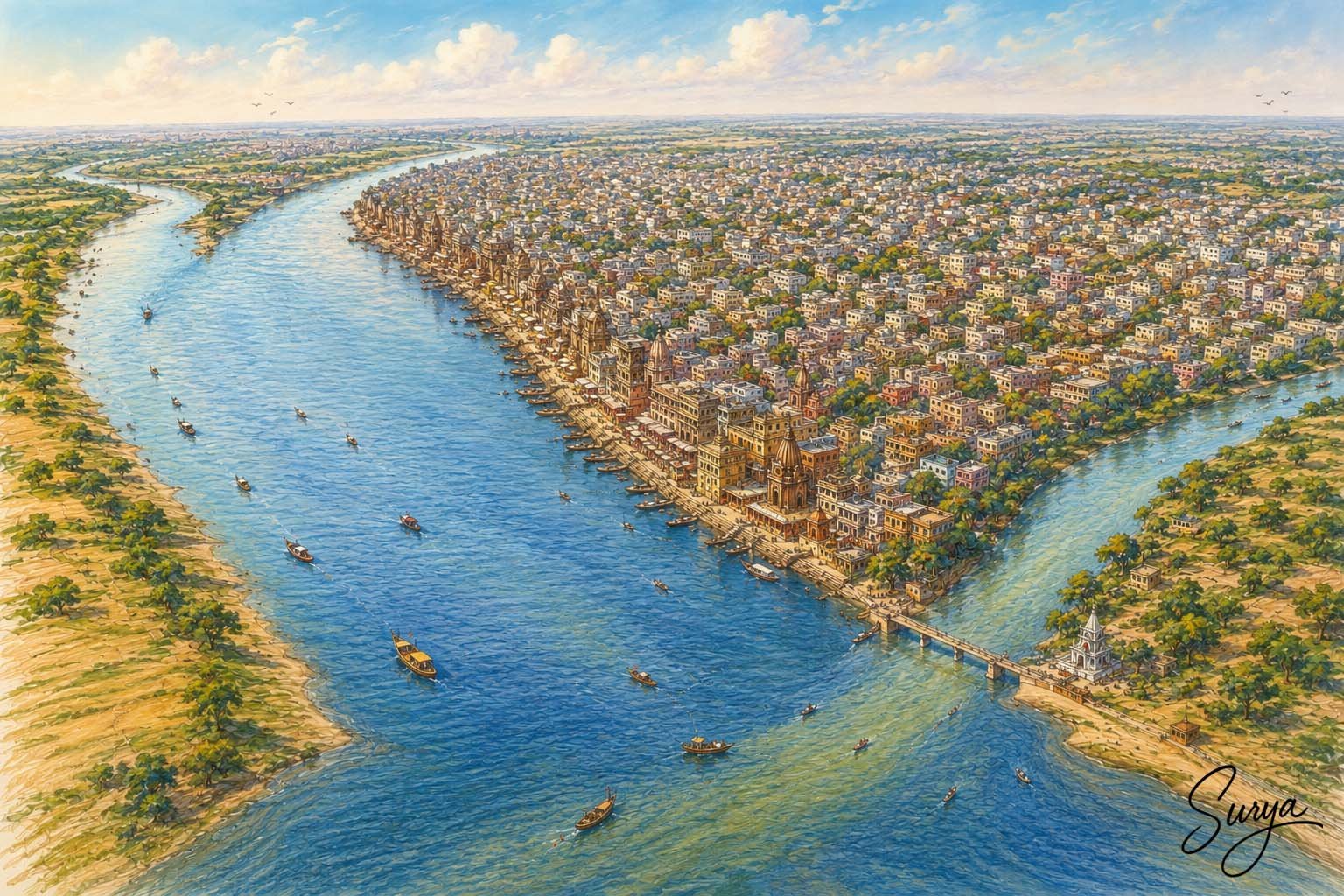
Benares (Varanasi)
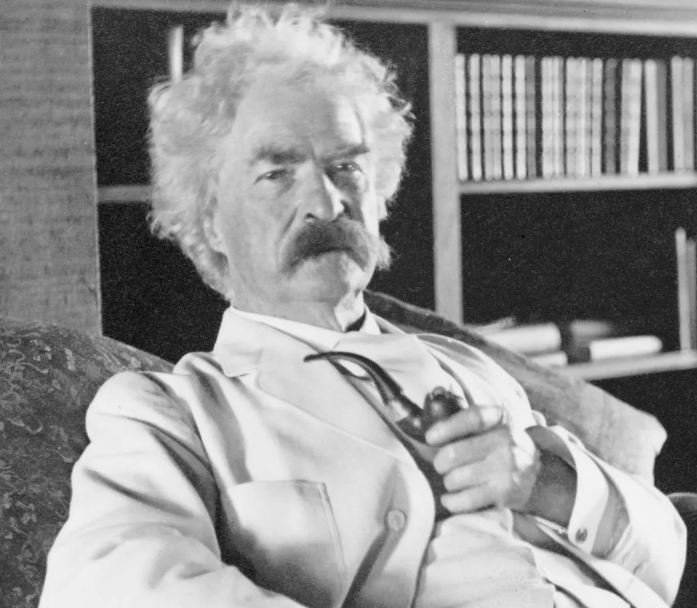
‘Following the Equator’ is a profound and expansive travelogue by the celebrated American author, Mark Twain.
Documenting his extensive global journey between 1895 and 1896, the book rises far above a mere chronological itinerary of a standard traveler. Instead, it emerges as an extraordinary narrative tapestry woven with sharp social commentary, subversive humor, and an unyielding, progressive critique of European imperialism at the absolute height of the colonial era. It was Published in 1897.
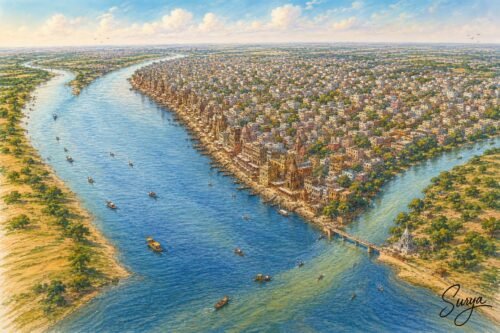
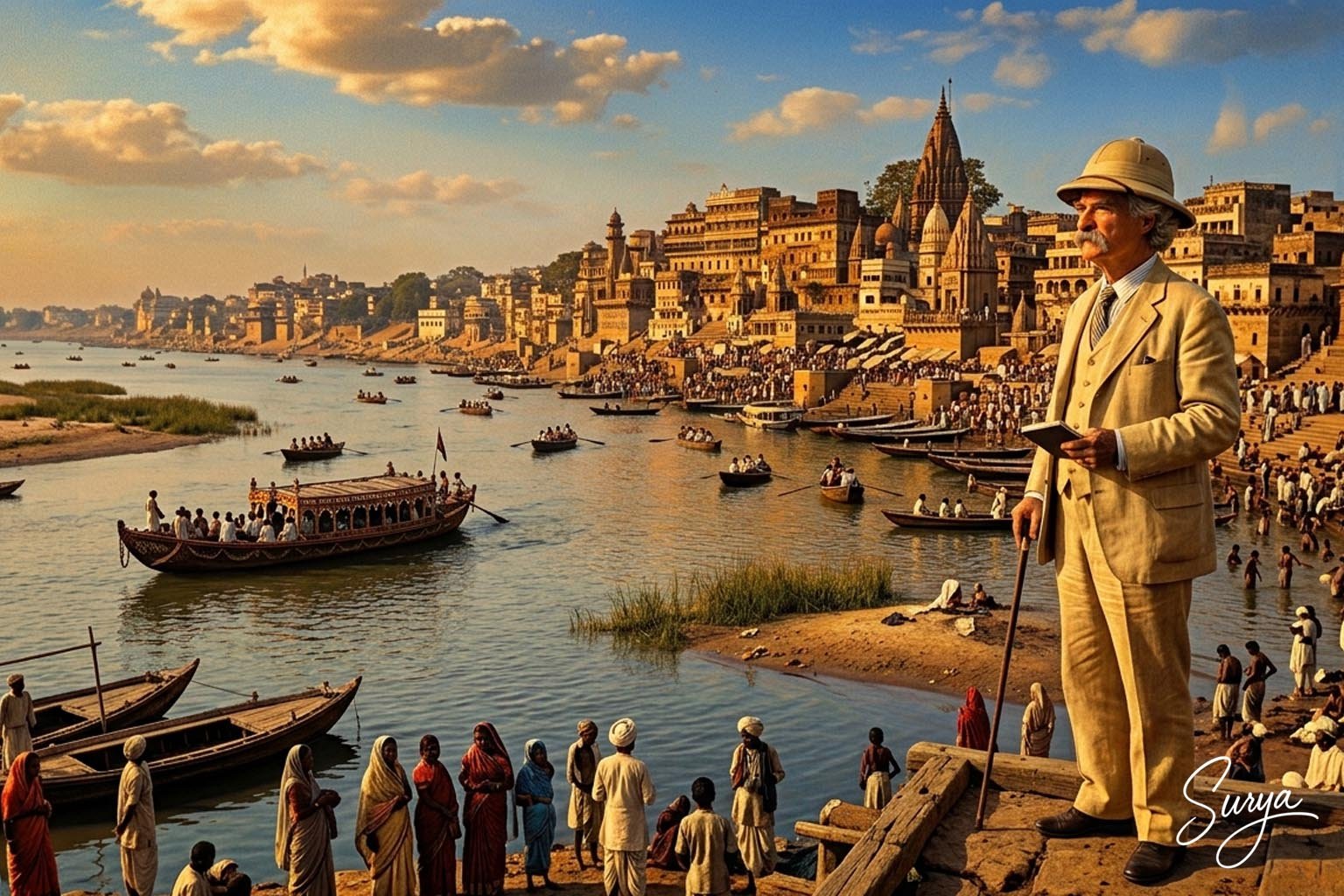
In his celebrated book Following the Equator, Twain deeply records his evocative and timeless reflections on his mesmerizing encounter with the sacred city of Benares.
The man who is ostentatious of his modesty is twin to the statue that wears a fig-leaf. — Pudd’nhead Wilson’s New Calendar.
THE journey to Benares was all in daylight, and occupied but a few hours. It was admirably dusty. The dust settled upon you in a thick ashy layer and turned you into a fakeer, with nothing lacking to the rdle but the cow manure and the sense of holiness. There was a change of cars about mid-afternoon at Moghul-serai — if that was the name — and a wait of two hours there for the Benares train. We could have found a carriage and driven to the sacred city, but we should have lost the wait. In other countries a long wait at a station is a dull thing and tedious, but one has no right to have that feeling in India. You have the monster crowd of bejeweled natives, the stir, the bustle, the confusion, the shifting splendors of the costumes — dear me, the delight of it, the charm of it are beyond speech. The two-hour wait was over too soon. Among other satisfying things to look at was a minor native prince from the backwoods somewhere, with his guard of honor, a ragged but wonderfully gaudy gang of fifty dark barbatians armed with rusty flint-lock muskets. The general show came so near to exhausting variety that one would have said that no addition to it could be conspicuous, but when this Falstaff and his motleys marched through it one saw that that seeming impossibility had happened.
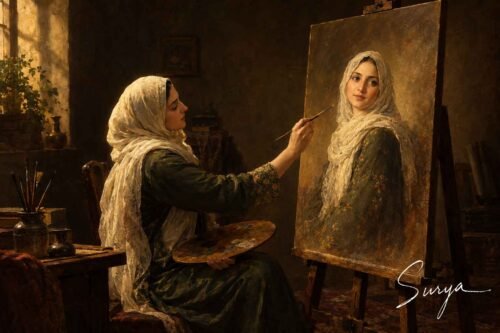
We got away by and by, and soon reached the outer edge of Benares; then there Avas another wait; but, as usual, with something to look at. This was a cluster of little canvasboxes — palanquins. A canvas-box is not much of a sight — when empty ; but when there is a lady in it, it is an object of interest. These boxes were grouped apart, in the full blaze of the terrible sun during the three-quarters of an hour that we tarried there. They contained zenana ladies. They had to sit up ; there was not room enough to stretch out. They probably did not mind it. They are used to the close captivity of their dwellings all their lives ; when they go a journey they are carried to the train in these boxes ; in the train they have to be secluded from inspection. Many people pity them, and I always did it myself and never charged anything ; but it is doubtful if this compassion is valued. While we were in India some good-hearted Europeans in one of the cities proposed to restrict a large park to the use of zenana ladies, so that they could go there and in assured privacy go about unveiled and enjoy the sunshine and air as they had never enjoyed them before. The good intentions back of the proposition were recognized, and sincere thanks returned for it, but the proposition itself met with a prompt declination at the hands of those who were authorized to speak for the zenana ladies. Apparently, the idea was shocking to the ladies — indeed, it was quite manifestly shocking. Was that proposition the equivalent of inviting European ladies to assemble scantily and scandalously clothed in the seclusion of a private park? It seemed to be about that.
Without doubt modesty is nothing less than a holy feeling ; and without doubt the person whose rule of modesty has been trangressed feels the same sort of wound that he would feel if something made holy to him by his religion had suffered a desecration. I say ” rule of modesty ” because there are about a million rules in the world, and this makes a million standards to be looked out for. Major Sleeman mentions the case of some liigh-caste veiled ladies who were profoundl}^ scandalized when some English young ladies passed by with faces bare to the world ; so scandalized that they spoke out with strong indignation
and wondered that people could be so shameless as to expose their persons like that. And yet “the legs of the objectors were naked to mid-thigh.” Both parties were cleanminded and irreproachably modest, while abiding by their separate rules, but they couldn’t have traded rules for a change without suffering considerable discomfort. All human rules are more or less idiotic, I suppose. It is best so, no doubt. The way it is now, the asylums can hold the sane people, but if we tried to shut up the insane we should run out of building materials.
You have a long drive through the outskirts of Benares before you get to the hotel. And all the aspects are melancholy. It i s a vision of dusty sterility, decaying temples, crumbling tombs, broken mud walls, shabby huts. The whole region seems to ache with age and penury. It must take ten thousand years of want to produce such an aspect. We were still outside of the great native city when we reached the hotel. It was a quiet and homelike house, inviting, and manifestly comfortable. But we liked its annex better, and went thither. It was a mile away, perhaps, and stood in the midst of a large compound, and was built bungalow fashion, everything on the ground floor, and a veranda, all around. They have doors in India, but I don’t know why. They don’t fasten, and they stand open, as a rule, with a curtain hanging in the doorspace to keep out the glare of the sun. Still, there is plenty of privacy, for no white person will come in without notice, of course. The native men servants will, but they don’t seem to count. They glide in, barefoot and noiseless, and are in the midst before one knows it. At first this is a shock, and sometimes it is an embarrassment ; but one has to get used to it, and does.
There was one tree in the compound, and a monkey lived in it. At first I was strongly interested in the tree, for I was told that it was the renowned peepul — the tree in whose shadow you cannot tell a lie. This one failed to stand the test, and I went away from it disappointed. There was a softly creaking well close by, and a couple of oxen drew water from it by the hour, superintended by two natives dressed in the usual ” turban and pocket-handkerchief.” The tree and the well were the only scenery, and so the compound was a soothing and lonesome and satisfying place ; and very restful after so many activities. There was nobody in our bungalow but ourselves ; the other guests were in the next one, Avhere the table d’hote was furnished, A body could not be more pleasantly situated. Each room had the customary bath attached — a room ten or twelve feet square, with a roomy stone-paved pit in it and abundance of water. One could not easily improve upon this arrangement, except by furnishing it with cold water and excluding the hot, in deference to the fervency of the climate ; but that is forbidden. It would damage the bather’s health. The stranger is warned against taking cold baths in India, but even the most intelligent strangers are fools, and they do not obey, and so they presently get laid up. I was the most intelligent fool that passed through, that year. But I am still more intelligent now. Now that it is too late.
Benares is older than history, older than tradition, older even than legend, and looks twice as old as all of them put together. From a Hindoo statement quoted in Rev. Mr. Parker’s compact and lucid Guide to Benares, I find that the site of the town was the beginning-place of the Creation. It was merely an upright “lingam,” at first, no larger than a Istove-pipe, and stood in the midst of a shoreless ocean. This was the work of the God Vishnu. Later he spread the lingam out till its surface was ten miles across. Still it was not large enough for the business; therefore he presently built the globe around it. Benares is thus the center of the earth. This is considered an advantage.
” During the past few years competent observers declare that the number of pilgrims to Benares has increased.”
And. then he adds up this fact and gets this conclusion :
” But the revival, if so it may be called, has in it the marks
of death. It is a spasmodic struggle before dissolution.”
In this world we have seen the Roman Catholic power dying, upon these same terms, for many centuries. Many a time we have gotten all ready for the funeral and found it postponed again, on account of the weather or something. Taught by experience, we ought not to put on our things for this Brahminical one till we see the procession move. Apparently one of the most uncertain things in the world is the funeral of a religion. I should have been glad to acquire some sort of idea of Hindoo theology, but the diificulties were too great, the matter was too intricate. Even the mere A, B, C of it is baffling.
There is a trinity — Brahma, Shiva, and Vishnu — independent powers, apparently, though one cannot feel quite sure of that, because in one of the temples there is an image where an attempt has been made to concentrate the three in one person. The three have other names and plenty of them, and this makes confusion in one’s mind. The three have wives and the wives have several names, and this increases the confusion. There are children, the children have many names, and thus the confusion goes on and on. It is not worth while to try to get any grip upon the cloud of minor gods, there are too many of them.
It is even a justifiable economy to leave Brahma, the chiefest god of all, out of your studies, for he seems to cut no great figure in India. The vast bulk of the national worship is lavished upon Shiva and Vishnu and their families. Shiva’s symbol — the ” lingam ” Avith which Vishnu began the Creation — is worshiped by everybody, apparently. It is the commonest object in Benares. It is on view everywhere, it is garlanded with flowers, offerings are made to it, it suffers no neglect. Commonly it is an upright stone, shaped like a thimble — sometimes like an elongated thimble. This priapus worship, then, is older than history. Mr. Parker says that the lingams in Benares ” outnumber the inhabitants.”
In Benares there are many Mohammedan mosques. There are Hindoo temples without number — these quaintly shaped and elaborately sculptured little stone jugs crowd all the lanes. The Ganges itself and every individual drop of water in it are
temples. Keligion, then, is the business of Benares, just as gold-production is the business of Johannesburg. Other industries
count for nothing as compared with the vast and all-absorbing rush and drive and boom of the town’s specialty. Benares
is t he sacredest of sacred cities. The moment you step across the sharply -defined line which separates it from the rest of the globe, you stand upon ineffably and unspeakably holy ground. Mr. Parker says : ” It is impossible to convey any adequate idea of the intense feelings of veneration and affection with which the pious Hindoo regards ‘ H oly Kashi ‘ (Benares).” And then he gives you this vivid and moving picture:
” Let a Hindoo regiment be marched through the district, and as soon as they cross the line and enter the limits of the holy place they rend the air with cries of ‘ Kashi ji ki jai — jai — jai ! (Holy Kashi ! Hail to thee ! Hail ! Hail ! Hail)’. The weary pilgrim scarcely able to stand, with age and weakness, blinded by the dust and heat, and almost dead with fatigue, crawls out of the oven-like railway carriage and as soon as his feet touch the ground he lifts up his withered hands and utters the same pious exclamation. Let a
European in some distant city in casual talk in the bazar mention the fact that he has lived at Benares, and at once voices will be raised to call down blessings on his head, for a dweller in Benares is of all men most blessed.”
It makes our own religious enthusiasm seem pale and cold. Inasmuch as the life of religion is in the heart, not the head, Mr. Parker’s touching picture seems to promise a sort of indefinite postponement of that funeral.